


Discover 6 top EDI platforms for retailers in 2026. Compare a variety of features and benefits to find the right solution for your supply chain needs.
In retail, EDI is not optional. Major retailers including Walmart, Target, Costco, and Home Depot require it before they will place orders with a supplier. The question is not whether you need EDI. It is which platform will get you live faster, keep you compliant without constant manual intervention, and scale without turning into a cost center as you add trading partners.
This guide covers the six best EDI platforms for retail and consumer brands in 2026: what each one does well, where each one falls short, and how to choose based on your actual situation.
What To Look For in an EDI Platform
A strong EDI platform should scale with your operations while keeping data exchange fast and accurate. Even minor delays can disrupt warehouse systems, vendor relationships, and customer satisfaction.
Look for a cloud-based solution that integrates with your ERP, supports multiple data formats, and automates routine tasks. Key features include vendor-managed inventory (VMI), direct store delivery (DSD), and real-time monitoring.
Transparent pricing, responsive support, and simple integration tools can help reduce errors and speed up onboarding, especially if you’re replacing legacy EDI systems.
If you are looking for a faster way to manage EDI across every trading partner, Orderful provides a modern API first platform designed for scale. You can learn more about how the platform works and review our pricing to see how simple, transparent plans fit your integration strategy.
6 Best EDI Platforms for Retail and Consumer Brands
With so many platforms on the market, it’s important to find an EDI integration that will align with your business size, workflows, and retail partner requirements. These platforms have stood out in the consumer retail market as leaders in the era of modern supply chain EDI.
1. Orderful
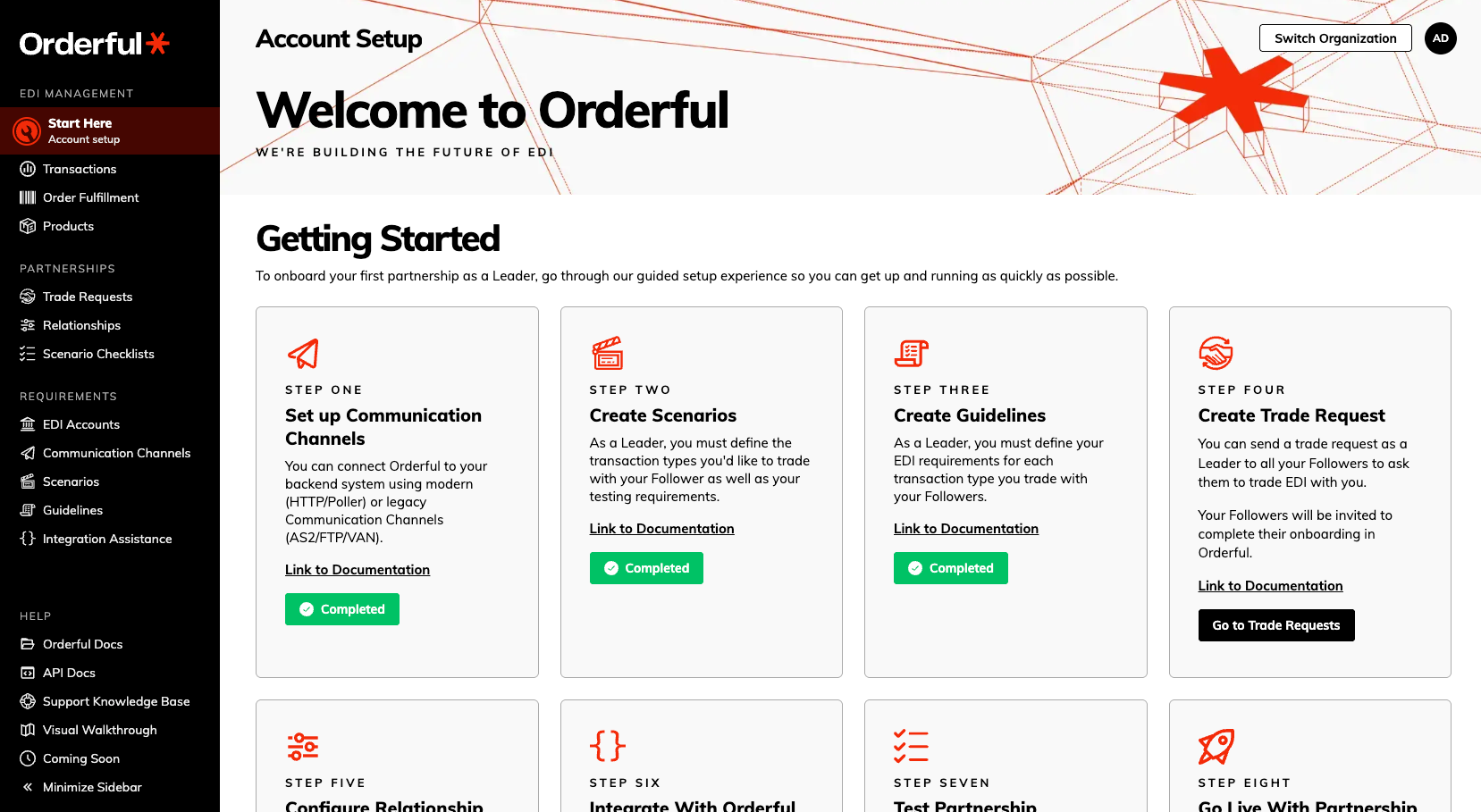
Orderful is a cloud-native, API-first EDI platform built specifically for retail supply chain operations. Its two products cover the full range of EDI needs: Mosaic for ERP-integrated, AI-native EDI that eliminates manual mapping entirely, and Pixel for browser-based Web EDI that gets smaller teams compliant without a technical integration.
What sets Orderful apart for retail brands is the combination of a pre-built partner network and real-time validation. When you add a new retailer, you are not starting a custom mapping project. Orderful maintains the requirements for thousands of trading partners, including Walmart, Target, Costco, Home Depot, and Amazon, so most of the configuration is already done. Customers go live with new trading partners in an average of nine days.
Flat-rate pricing at $189 per month per trading partner means costs are predictable regardless of transaction volume. No per-transaction fees, no bill shock during peak season. You can review the full breakdown on the pricing page.
What Orderful does well:
- Average nine-day onboarding across thousands of pre-built retail partner connections
- AI-native Mosaic platform eliminates manual EDI mapping entirely
- Real-time validation catches errors before documents reach trading partners, preventing chargebacks
- Transparent flat-rate pricing with no transaction fees
- Supports retail-specific workflows including DSD, VMI, and drop ship
- 24/7 EDI expert support included in every plan
Potential challenges:
- Teams with existing, heavily customized legacy EDI infrastructure may need a migration plan before switching
2. SPS Commerce
SPS Commerce is an established EDI provider in the retail industry, with an extensive network of pre-built connections to thousands of retailers, suppliers, and logistics providers. It supports a wide range of electronic documents and workflows, making it a reliable option for expanding your supply chain footprint.
SPS works well for companies that value access to a large partner network and support for advanced data formats. Its managed services model appeals to teams with limited tech resources or those avoiding day-to-day EDI management.
What SPS Commerce does well:
Extensive retail partner network with strong market penetration
Built-in support for product data management and advanced formats like global data synchronization (GDSN)
Fully managed EDI services reduce internal lift
Strong onboarding programs for established ERP (enterprise resource planning) systems
Potential challenges:
More costly than most other options, especially for small or midsize brands
Scope and complexity often result in longer onboarding times
Limited flexibility in workflows and custom integration paths
3. TrueCommerce
TrueCommerce offers a unified commerce platform that supports retail and wholesale operations. It provides out-of-the-box connectors for popular ERP systems and ecommerce platforms, making it easy to automate order processing and shipping notices across sales channels.
TrueCommerce is ideal for businesses looking to unify supply chain and commerce functions. Its modular setup lets teams adopt only what they need without overcommitting to full implementation.
What TrueCommerce does well:
Extensive library of pre-built connectors for ERP, ecommerce, and marketplace platforms
Strong multi-channel commerce capabilities
Managed services available for businesses that want hands-off operations
Potential challenges:
Interface can feel dated compared to newer platforms
Support response times may vary based on the service level tier
4. Cleo Integration Cloud
Cleo Integration Cloud is a hybrid EDI and API platform designed for end-to-end control across complex ecosystems. Known for its flexible architecture, Cleo enables businesses to manage traditional EDI and modern API-based data exchange through a unified interface.
Cleo supports high-volume retail and logistics workflows with customizable dashboards, automation tools, and pre-built ERP and TMS connectors. It’s a strong fit for businesses managing multiple units or international trade.
What Cleo Integration Cloud does well:
Enables businesses to centralize EDI and API integrations on a single platform
Robust tools for data integration, error handling, and visibility
Strong support for high-complexity workflows and multi-enterprise ecosystems
Scalable solution for global supply chains
Potential challenges:
May be overpowered for smaller brands with simpler supply chains
Pricing can increase with customization and volume
5. IBM Sterling EDI VAN
IBM Sterling EDI VAN is a longstanding provider that enables businesses to securely exchange digital business documents with thousands of trading partners across a private, managed network, offering robust data integration, visibility, and compliance tools.
IBM Sterling is designed for companies with high volumes, complex partner networks, or stringent compliance requirements. Common in regulated industries such as retail and healthcare, it offers strong audit support, security, and scalability, backed by 24/7 service.
What IBM Sterling does well:
Enterprise-level EDI VAN infrastructure with secure and reliable data exchange
Built-in tools for compliance, document archiving, and audit support
Seamless integration with IBM Sterling B2B Integrator and other IBM tools
Strong support for high-volume and high-complexity operations
Potential challenges:
Cost structure may be prohibitive for smaller or mid-market brands
Implementation and customization often require IBM-certified specialists
6. DiCentral
Now a part of TrueCommerce, DiCentral is popular among midsize and enterprise-level retail brands, supporting complex integrations across diverse supply chain management environments. This enables businesses to maintain a consistent and accurate flow of EDI documents between internal systems and external partners.
DiCentral supports omnichannel operations with real-time visibility and configurable workflows, as well as API-EDI hybrid integration.
What DiCentral does well:
Strong support for omnichannel retail and global supply chain integration
Real-time data exchange across EDI, API, and ERP systems
Modular features for scaling EDI capabilities alongside business growth
Reliable performance across multiple industries and trading networks
Potential challenges:
Now integrated into the TrueCommerce ecosystem, some features may overlap or require migration
Pricing and support tiers can vary depending on the service bundle
Comparison of Top EDI Providers for Retail Brands
Platform | Best For | Key Strengths | Potential Drawbacks |
|---|---|---|---|
Orderful | Fast onboarding, retail compliance | API-first, 9-day avg. onboarding, AI-native mapping, VMI & DSD support, flat-rate pricing | Migration planning needed for legacy-heavy setups |
SPS Commerce | Large networks, managed services | Vast trading partner list, fully managed model | High cost, long onboarding |
TrueCommerce | Unified commerce, ERP connectors | Multichannel, modular approach | UI feels dated, tiered support |
Cleo | Hybrid EDI/API, enterprise scale | Centralized data visibility | Overpowered for smaller orgs, costly custom |
IBM Sterling | Regulated industries, audit-heavy | Secure, scalable, compliance tools | Expensive, steep implementation curve |
DiCentral | Omnichannel & global operations | API/EDI hybrid, strong modular scaling | Feature overlap post-merger with TrueCommerce |
Choosing the Right Platform for Your Brand
With numerous EDI platforms available, narrowing your options begins by identifying the features that align with your retail workflows, trading partner requirements, and long-term growth plans. Whether you need a full-service integration partner or a lightweight EDI solution for rapid compliance, the right platform will offer the flexibility and functionality to grow with you.
This checklist will help you determine what to prioritize:
Scalable solution that supports new sales channels and business models
EDI capabilities for key documents like purchase orders, invoices, and advance ship notices
Compatibility with your ERP and back office systems
Support for different data formats to reduce errors and simplify onboarding
Tools to eliminate manual data entry and automate the EDI process
Flexible support for multiple solutions, including web EDI and API integrations
A vendor that enhances your business agility instead of slowing you down
Every retailer’s needs are different, but choosing a solution that removes technical barriers and accelerates EDI adoption can be a smart investment, especially as digital supply chains continue to evolve.
Smart EDI for Modern Retailers
Orderful's modern EDI platform helps retail brands go live with trading partners in days, not months, with flat-rate pricing, real-time compliance validation, and no mapping overhead. Talk to our team to see what your onboarding timeline and costs would actually look like.
